Blocka Concept
A Simple 3D Coin
Details
Blocka started as a personal study focused on narrative applied to product visualization. More than simply modeling a 3D Bitcoin coin, I wanted to create context
Year
2026
SOFTWARES
Cinema 4D, Redshift, After Effects
AUTOR
Mateus Otto

Technically, the main goal was to test Cryptomatte applications within the pipeline. I extracted multiple passes to gain greater control in post-production, adjusting reflections, bloom, and contrast individually rather than relying solely on the final render.
It became an exercise in integrating rendering and compositing, aiming for greater creative control and refinement in the final result.
References (MoodBoard)
Technically, the main goal was to test Cryptomatte applications within the pipeline. I extracted multiple passes to gain greater control in post-production, adjusting reflections, bloom, and contrast individually rather than relying solely on the final render.
It became an exercise in integrating rendering and compositing, aiming for greater creative control and refinement in the final result.
References (MoodBoard)

After studying the references, I began the process using an SVG created in Illustrator, which was then imported into Cinema 4D. From there, I developed the extrusions and built the base modeling of the coin.
To enhance the details, I used Delowny within Extrude > Caps, generating a more refined and organic mesh with better polygon distribution. This process allowed for greater precision in the engravings and a more consistent result in lighting and materials.
After studying the references, I began the process using an SVG created in Illustrator, which was then imported into Cinema 4D. From there, I developed the extrusions and built the base modeling of the coin.
To enhance the details, I used Delowny within Extrude > Caps, generating a more refined and organic mesh with better polygon distribution. This process allowed for greater precision in the engravings and a more consistent result in lighting and materials.
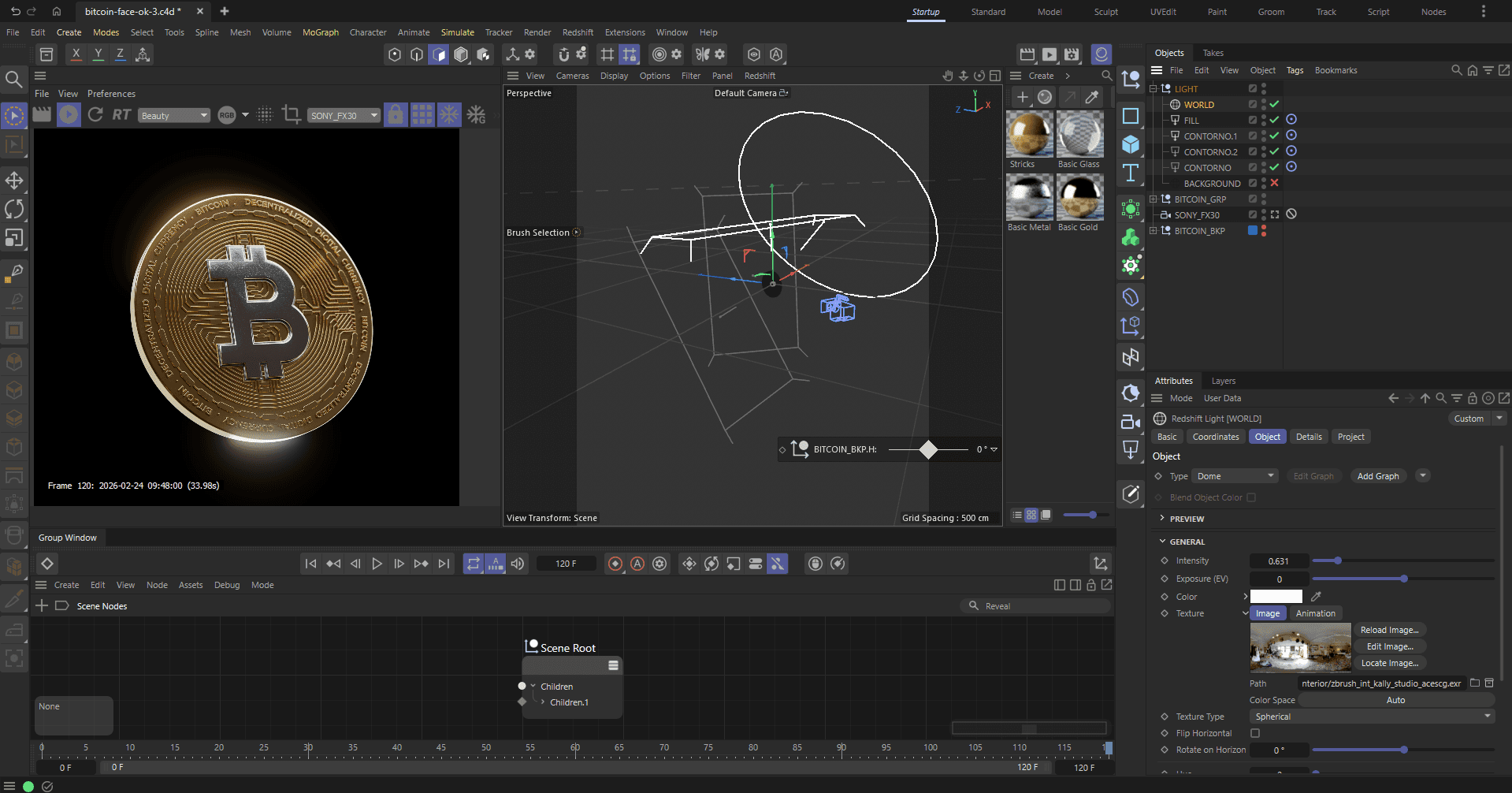

Tests like this show that choosing the right techniques can lead to extremely satisfying results. Additionally, exploring new tools and different ways of executing the same work expands knowledge and strengthens the creative process.
Tests like this show that choosing the right techniques can lead to extremely satisfying results. Additionally, exploring new tools and different ways of executing the same work expands knowledge and strengthens the creative process.
Technically, the main goal was to test Cryptomatte applications within the pipeline. I extracted multiple passes to gain greater control in post-production, adjusting reflections, bloom, and contrast individually rather than relying solely on the final render.
It became an exercise in integrating rendering and compositing, aiming for greater creative control and refinement in the final result.
References (MoodBoard)
After studying the references, I began the process using an SVG created in Illustrator, which was then imported into Cinema 4D. From there, I developed the extrusions and built the base modeling of the coin.
To enhance the details, I used Delowny within Extrude > Caps, generating a more refined and organic mesh with better polygon distribution. This process allowed for greater precision in the engravings and a more consistent result in lighting and materials.
Tests like this show that choosing the right techniques can lead to extremely satisfying results. Additionally, exploring new tools and different ways of executing the same work expands knowledge and strengthens the creative process.